What Does NEASC Accreditation Mean for Your Child’s Education?
What does NEASC accreditation mean for your child’s education? It means your child learns in a school that meets globally recognized standards for academic quality, operational safety, and continuous improvement.
This prestigious framework ensures international schools deliver rigorous, research-based instruction that directly prepares students for success at top universities worldwide.
Understanding NEASC Accreditation: A Mark of Educational Excellence
Understanding NEASC accreditation is essential because it represents a legacy of educational excellence verified through rigorous self-reflection and external peer review.
Established in 1885, NEASC stands as one of the oldest and most globally respected educational accrediting organizations. The accreditation process demands rigorous internal self-reflection, objective peer review, and continuous strategic growth.
Schools must prove they meet high, research-based standards regarding safety, governance, and holistic teaching. Universities and educational institutions worldwide highly recognize and trust this accreditation.
Accreditation is not a one-time achievement; it requires ongoing cycles of evaluation, reporting, and strategic growth. ISHCMC maintains its accreditation through continuous improvement, regularly demonstrating how we implement feedback, adapt to evolving educational research, and consistently enhance our programs. This commitment to perpetual growth ensures that our educational offerings remain at the forefront of international best practices.
How International Schools Can Meet NEASC Accreditation Standards
Understanding “what does NEASC accreditation mean for your child’s education?” helps parents recognize how specific school standards create tangible daily benefits. The following table shows exactly how NEASC standards translate into direct advantages for your child.
| Standards | Standards | Benefit to your child |
| A. Learning Structure and Principles | ✅Schools must implement interactive, student-centered curriculums that replace lecture-heavy methods with open discussion and independent critical thinking. | Promotes active engagement, cultivates future-ready problem-solving skills, and guarantees high-quality, modern teaching. |
| B. Governance, Leadership, and Staffing | ✅Schools must separate board and administrative roles while deploying robust financial models and rigorous recruitment practices for fully credentialed educators. | Ensures institutional stability, delivers highly qualified instructors, and guarantees equal treatment for all learners. |
| C. Health, Safety, and Child Protection | ✅Schools must establish mandatory reporting procedures, conduct staff background checks, optimize facility layouts, and write mental health support into policy. | Creates a secure sanctuary, supports emotional well-being, and gives students a trusted voice to report distress. |
| D. Finance, Facilities, and Resources | ✅Schools must prove that tuition and capital are funneled directly back into upgrading laboratories, expanding digital technology, and maintaining libraries. | Enriches the learning environment with modern tools and prevents abrupt resource deprivation mid-year. |
| F. Culture, Inclusivity, and Global Citizenship | ✅Schools integrate global perspectives into the curriculum, celebrate diversity, and enforce clear anti-discrimination policies to systematically remove barriers to belonging. | Fosters a deep sense of belonging and shapes empathetic global citizens ready for an interconnected world. |
ISHCMC and NEASC Accreditation: Building a Future-Ready Education
Parents often ask, “What does NEASC accreditation mean for your child’s education?” within the specific context of our school community. At ISHCMC, this accreditation works in perfect harmony with our IB programs to build a truly future-ready educational experience.
A Dual Framework: NEASC and the IB Working in Harmony
NEASC and the IB work in harmony because the external peer-review process validates the authentic, high-quality implementation of our IB programs.
As HCMC’s first IB World School, we maintain NEASC accreditation alongside our full IB Continuum. This dual-layered framework ensures our PYP, MYP, and DP implementations align perfectly with global best practices.

NEASC external reviews confirm our IB programs deliver genuine, globally recognized, inquiry-driven education. Our accredited curriculum explicitly drives the critical thinking, research, and collaboration skills the IB requires.
This synergy guarantees students receive an education that is both rigorously quality-checked and highly respected by top universities.
Accredited Proof of Our Commitment to Every Learner
NEASC provides accredited proof of our commitment to every learner by requiring documented evidence that schools successfully cater to diverse learning needs.
- NEASC standards validate our three distinct graduation pathways: the Full IB Diploma, IB Courses, and the ISHCMC High School Diploma.
- Our personalized EAL support and Intensive English Language Program (IELP) meet rigorous NEASC benchmarks for specialized student intervention.
- Our faculty meets NEASC expectations, with 65% holding master’s degrees and an average of 9+ years of experience.
Furthermore, NEASC validates our whole-school POSISH – a holistic social-emotional learning framework, confirming that our social-emotional learning practices meet international standards of care. This recognition affirms that we prioritize not just academic achievement but the holistic well-being of every student, creating an environment where children feel safe, supported, and valued as individuals.
Proven Results: From Accredited Classrooms to Global Universities
The true meaning of our NEASC accreditation lies in the proven results it secures for our students in global university placements.
Universities worldwide recognize the NEASC seal as a mark of uncompromising rigor, granting ISHCMC applicants an immediate advantage during competitive admissions reviews.
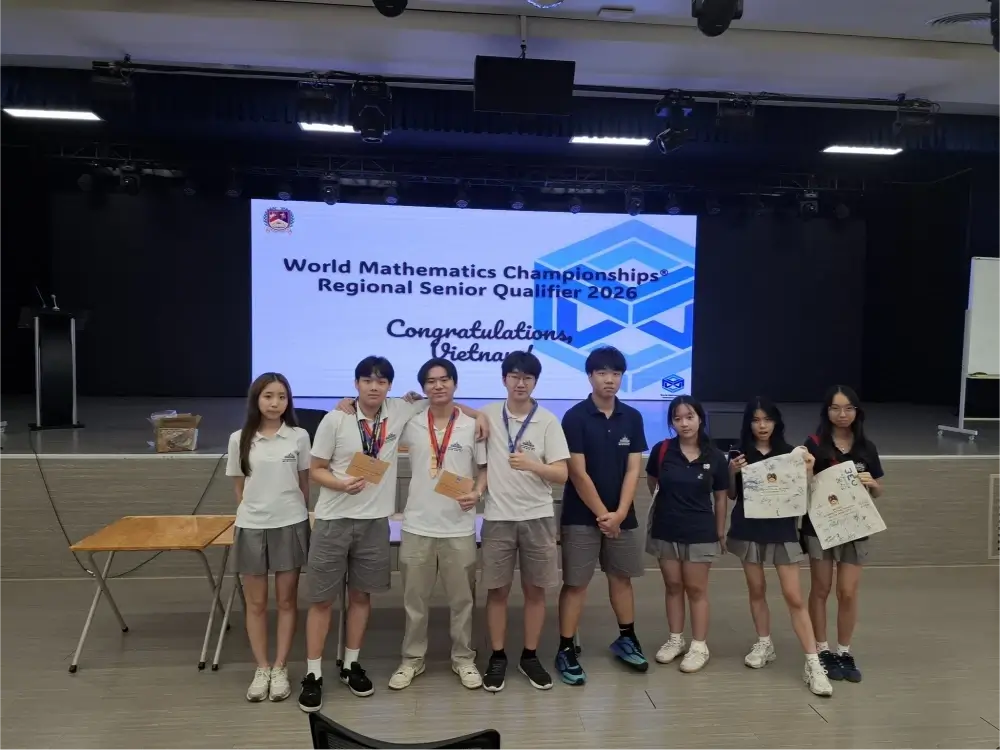
Class of 2026, our students secured 2,068 university offers and $112 million USD in scholarships, averaging 13.79 offers per student.
Our NEASC-backed educational model empowers students to gain admission to 7 of the top 10 QS-ranked global institutions, including Harvard, Oxford, Yale, and Seoul National University, giving your family complete peace of mind for the future.
Take the Next Step: NEASC Excellence Awaits at ISHCMC
Taking the next step at ISHCMC means choosing a school that actively leverages NEASC standards to provide an exceptional, future-ready learning experience.
We maintain a continuous commitment to educational excellence and ongoing strategic improvement. Our students benefit daily from the powerful combination of the IB framework and NEASC quality assurance.

Schedule a campus tour to see our NEASC-accredited learning environment and state-of-the-art facilities firsthand.
Contact our admissions team to apply now and give your child the lifelong advantage of an ISHCMC education.
FAQs
To further clarify “what does NEASC accreditation mean for your child’s education?”, we have answered some common questions from parents.
1. Can parents participate in the NEASC accreditation process?
Yes, NEASC requires schools to gather extensive parent feedback through surveys and focus groups. This input directly influences the school’s strategic improvement plans and operational goals.
2. What happens if a school fails to meet a specific NEASC standard?
The school must submit a detailed action plan addressing the deficiency within a strict timeline. NEASC conducts follow-up visits to ensure the school implements necessary changes before granting continued accreditation.
3. Does NEASC evaluate extracurricular activities and sports programs?
NEASC assesses whether co-curricular programs align with the school’s mission and contribute to holistic student development. They look for equitable access and adequate resources supporting these essential activities.
4. How does NEASC ensure a school's financial stability?
NEASC reviews financial audits, reserve funds, and long-term budget projections to verify institutional sustainability. This rigorous financial oversight guarantees the school can maintain its educational quality without sudden disruptions.
5. Is NEASC accreditation relevant for primary school students?
Absolutely, NEASC evaluates early childhood and primary programs to ensure foundational learning meets international best practices. It confirms that young learners engage in developmentally appropriate, safe, and stimulating environments.
6. How does NEASC handle curriculum changes at an accredited school?
Accredited schools must submit a Substantive Change Report or Application only for major curriculum or program departures (e.g., adding distance learning or major mission shifts). To maintain rigorous standards, NEASC reviews these updates against the school’s mission and Foundational Standards.