


How ISHCMC Uses MAP Testing to Personalise Learning
How ISHCMC uses MAP testing to personalise learning begins with understanding that MAP (Measures of Academic Progress) is an adaptive assessment that adjusts to each student’s ability level.
We implement MAP testing as a cornerstone of our personalized learning approach, using data-driven instruction to meet individual needs and tailor educational experiences across all grade levels.
How MAP Data Drives Personalization at ISHCMC
MAP data drives personalization at ISHCMC by establishing clear academic baselines, identifying precise learning gaps, and guiding targeted instructional adjustments across all grade levels.
Without a reliable starting point, personalization remains guesswork. We establish a baseline through benchmark testing, followed by structured data reviews to ensure consistent growth tracking across all K-12 terms.

Teachers and instructional coaches convene regularly to identify school-wide and class-wide learning trends, review Student Profile reports, and set measurable, student-owned goals. This collaborative analysis ensures that our educational strategies remain responsive to the evolving needs of our diverse student body.
Our educators use this collaborative data analysis to execute specific personalization strategies in their daily instruction:
- Teachers map individual RIT scores against the Learning Continuum to identify each student’s unique zone of proximal development, ensuring they receive appropriately challenging material.
- We adjust scaffolding, implement flexible small-group instruction, and utilize Instructional Connections partners to adapt independent learning paths based on real-time performance data.
- We use normative and state linking data to quickly identify struggling learners needing Tier II/III interventions, alongside advanced students requiring curriculum compacting for accelerated enrichment.
- Our specialists use data insights for progress monitoring, coordinating with MTSS (Multi-Tiered System of Supports), and outlining personalized interventions that target specific skill deficits.

This continuous feedback loop ensures that instruction remains dynamic. Rather than waiting for end-of-year exams, teachers pivot their strategies immediately when MAP data reveals new insights. Teachers hold data conferences with students, fostering a culture of ownership where learners understand their own RIT scores and actively participate in setting their academic targets.
This agile approach guarantees that how ISHCMC uses MAP testing to personalise learning remains an active, ongoing process rather than a static event.
Leveraging Our 1:1 Technology Program for Seamless Testing
We leverage our 1:1 technology program for seamless testing by providing familiar, developmentally appropriate devices that eliminate technical barriers during assessments.
- Our staged 1:1 technology program (iPads for Grades 2-5, MacBooks for Grades 6-12) provides a familiar, consistent digital environment for MAP testing.
- The advantage of being an Apple Distinguished School ensures our devices and robust network infrastructure perfectly support high-stakes digital assessments without technical friction.
- Because our students use these exact devices daily for research, creation, and collaboration, they interact with the MAP interface with confidence and ease, ensuring technology never acts as a barrier during assessments.
- We use shared iPads in Early Years and Grade 1 to build the foundational digital skills needed for formal MAP testing in Grade 2.
Facilitating Smooth Academic Transitions Using MAP Data
Moving between campuses is a significant milestone that can often disrupt academic momentum. We use MAP data to ensure academic continuity as students move from our Primary Campus to our Secondary Campus.
The role of MAP growth projections in our dedicated Grade 5 transition program gives secondary teachers an immediate, objective understanding of incoming students’ strengths.
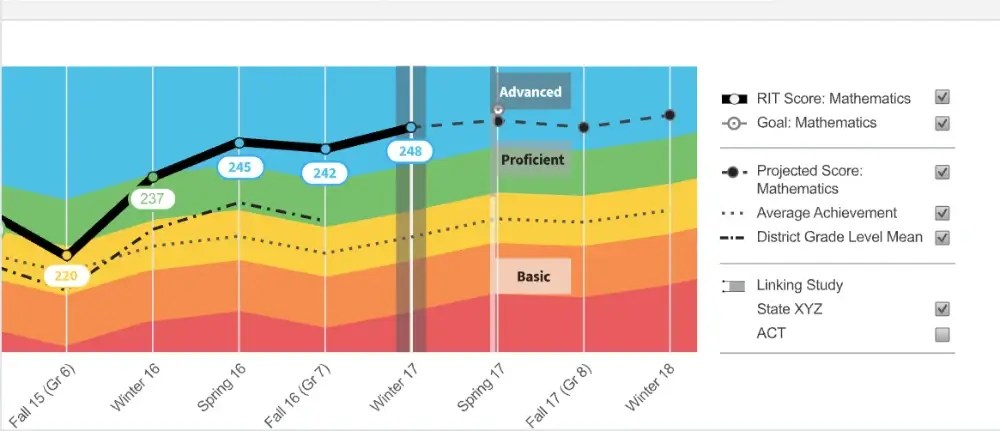
Source: Student Profile from MAP Growth Help Center
This data-sharing protocol delivers several key benefits:
- Sharing MAP data between primary and secondary academic leads prevents any “learning loss” or repetition during the campus transition.
- The reassurance this data provides to parents and students reduces anxiety during a significant milestone in their educational journey.
- Secondary teachers can design initial units that precisely match the confirmed skill levels of the incoming cohort, ensuring immediate academic engagement.
Providing Tailored Testing Accommodations and Support
MAP Testing Implementation Across Grade Levels at ISHCMC
At ISHCMC, we recognize that standardized testing can induce stress, particularly for students with diverse learning profiles. To counter this, we design testing sessions that prioritize the well-being and comfort of every learner.
We implement appropriate testing accommodations for students with identified learning needs to ensure MAP results accurately reflect their true ability. Our highly trained Teaching Assistants (TAs), who undergo extensive professional development through platforms like EduSpark, provide crucial continuity and support during testing sessions.
 Meanwhile, our culture of care ensures testing environments remain low-stress, utilizing mindfulness strategies and flexible scheduling when needed to optimize student performance.
The collaboration between our Learning Support team, counselors, and homeroom teachers determines the best individualized testing conditions for each student.
Measuring Success: ISHCMC's MAP Results and Learning Impact
Our consistent leadership in MAP assessments across Ho Chi Minh City international schools validates the effectiveness of our personalized approach.
Specific performance data highlights this success: our Grade 5 students exceeded US norms by 14 points in Math, 9 points in Reading, and 9 points in Language Usage. We observe a direct correlation between these MAP results and other academic achievements at ISHCMC, including strong performance in our IB programs.

Furthermore, external research validates our innovative methods. In a four-month UCL Innovation Fellowship study, our Grade 5 EAL students utilized the Apple Clips app to create weekly video reflections paired with speech-to-text transcription. This multimedia approach encouraged expressive language use.
The results were remarkable: these EAL students achieved MAP Reading growth to the 68th percentile (compared to 46th percentile for peers) and Language Usage to the 65th percentile (compared to 42nd percentile). This study proves that when we pair adaptive data with creative, personalized instruction, the impact on language acquisition is profound.
These measurable outcomes validate how ISHCMC uses MAP testing to personalise learning and provide a clear roadmap for continuous improvement across our classrooms.
Final Thoughts
The challenge of meeting diverse academic needs within a single classroom is solved through precise, data-driven personalization. How ISHCMC uses MAP testing to personalise learning transforms static assessment scores into dynamic instructional roadmaps.

By adapting our teaching to exactly what each child needs, we ensure every student achieves meaningful, measurable academic growth.
We invite you to apply for ISHCMC or sign up for a consultation to discover how our data-driven approach can unlock your child’s full potential.
FAQs
Parents often ask about how ISHCMC uses MAP testing to personalise learning, so we have provided clear answers to the most frequent questions below.
1. How often does ISHCMC administer MAP tests?
We conduct MAP testing twice yearly – in September and May, allowing us to track growth consistently and make timely instructional adjustments. This regular assessment cycle provides multiple data points to identify trends rather than relying on single snapshots of student performance.
2. Can MAP testing accommodate students with learning differences?
Yes, we provide appropriate accommodations such as extended time, separate testing environments, or assistive technology based on each student’s documented needs. Our Learning Support team collaborates with teachers to ensure these accommodations maintain assessment validity while reducing barriers to demonstrating knowledge.
3. What happens if my child scores below grade level on MAP?
We use below-grade-level scores as diagnostic information to identify specific skill gaps and design targeted interventions rather than as judgmental labels. Our Multi-Tiered System of Supports ensures students receive appropriate additional instruction, monitoring progress closely to verify that interventions are effective.
4. Do MAP results influence class placement or tracking?
MAP data informs instructional grouping within classes and helps identify students who might benefit from additional support or challenge, but we don’t use it for rigid tracking or permanent placement decisions. Our flexible grouping approach allows students to move between groups as their skills develop and their needs change.