
Understanding the IB Physics HL Curriculum
The IB Physics HL curriculum is a rigorous pathway preparing students for university science and engineering. For STEM aspirants, it is a critical academic portfolio component.
This guide outlines the syllabus structure, assessment methods, SL vs. HL distinctions, and the support systems essential for success.
The Structure of the IB Physics HL Curriculum
Under the current curriculum (first assessment 2025), the course is organized into five broad themes: Space, Time and Motion; The Particulate Nature of Matter; Wave Behaviour; Fields; and Nuclear and Quantum Physics. This thematic approach fosters a holistic understanding of the physical world.
The course requires 240 teaching hours, more than the 150 hours for Standard Level (SL), reflecting the depth of study required.

A key component is the “Nature of Science,” which encourages students to understand scientific methods, ethics, and the limitations of scientific claims.
Additionally, the mathematical demand is higher in HL, requiring students to handle complex calculations and data analysis.
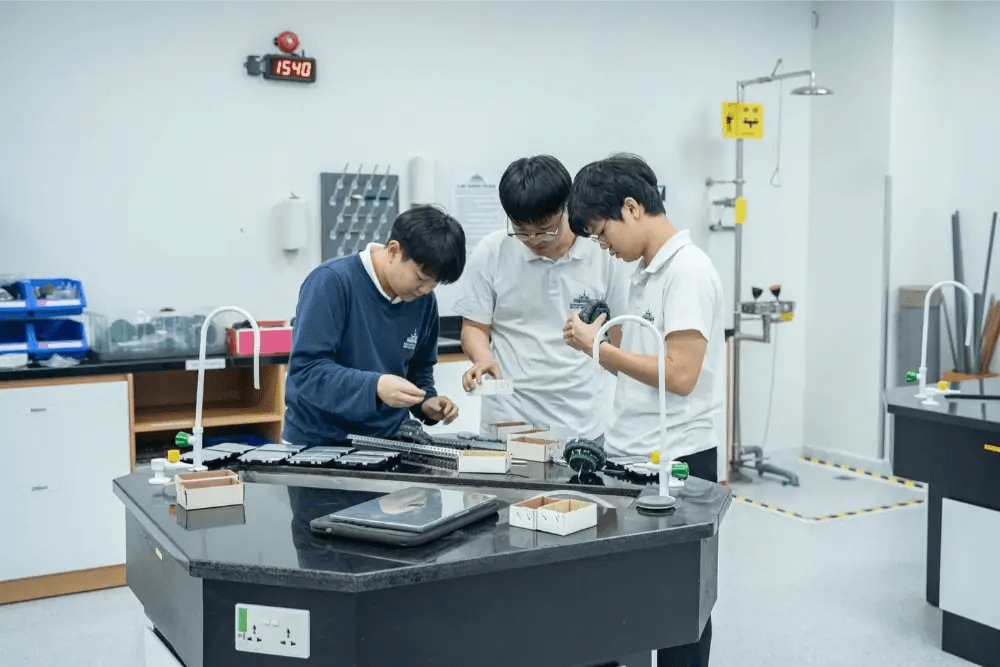
At ISHCMC, our students navigate these rigorous themes in an environment supported by purpose-built specialist science labs, allowing for the practical application of theoretical concepts.
Core Topics and Additional Higher Level (AHL) Content
The curriculum distinguishes between core material and advanced Higher Level content, culminating in collaborative projects. Students must master standard concepts while engaging deeply with Additional Higher Level (AHL) material.
Essential Topics in the IB Physics HL Curriculum
Students in the IB Physics HL curriculum encounter a significant distinction between core topics and the more challenging AHL material. Core topics form the foundation taken by all students, while AHL material takes these concepts to a deeper level. For example, while all students study mechanics, HL students engage with complex motion scenarios and gravitation.
- Core vs. AHL: HL students must master additional, abstract concepts beyond the basic tenets covered in SL.
- AHL Depth: Specific challenging areas include Nuclear and Quantum Physics, which are crucial for future engineering degrees.
- Practical Work: The “Scientific Investigation” (Internal Assessment) is vital, requiring students to design their own experiments to demonstrate practical application of theory.

The Role of the Group 4 Project
The Group 4 Project is a compulsory collaborative activity where students from different science disciplines work together to solve problems. This project mirrors real-world scientific collaboration, emphasizing interdisciplinary communication and skill development.
At ISHCMC, we facilitate these collaborative projects in our high-tech classrooms and design studios, encouraging students to apply interdisciplinary skills to real-world challenges.
=> Learn more: Six Subject Groups of IB Diploma Programme.
Assessment Model for IB Physics HL
Student performance is evaluated through demanding external examinations and an independent scientific investigation. The assessment model is designed to test both theoretical knowledge and practical application skills.
External assessment consists of two final examination papers.
- Paper 1 accounts for 36% of the grade and includes multiple-choice questions (Paper 1A) and data-based questions (Paper 1B).
- Paper 2 accounts for 44% and covers both Core and AHL material through data-based, short-answer, and extended-response questions.
The Internal Assessment (IA) involves an independent, 3,000-word scientific investigation. This investigation is assessed on four criteria: Research Design, Data Analysis, Conclusion, and Evaluation.
It contributes 20% to the final grade, while external exams make up the remaining 80%. The use of technology, such as calculators and data logging software, is integral to these assessments.
At ISHCMC, our experienced educators, 65% of whom hold master’s degrees, guide students through the rigorous IA process, ensuring they are well-prepared for university-level research.
The Value of the IB Physics HL Curriculum for University Admissions
The IB Physics HL curriculum offers significant advantages for university admissions, including credit transfer opportunities and skill development.

Universities globally regard this course as excellent preparation for degrees in Physics, Engineering, and Computer Science. Many top-tier universities in the US and UK offer course credits for high scores in IB Physics HL, potentially saving time and tuition fees.
The curriculum also develops critical thinking, data analysis, and problem-solving skills, competencies valued in any career. This rigorous preparation ensures students are ready for the demands of tertiary education.
Summary Table
| Feature | Standard Level (SL) | Higher Level (HL) |
| Teaching Hours | 150 hours | 240 hours |
| Content Scope | Core topics only | Core topics + Additional Higher Level (AHL) |
| Mathematical Demand | Foundational | Advanced (Calculus/Complex Analysis) |
| Ideal Pathway | Non-STEM or General Science | Engineering, Physics, Competitive STEM |
How ISHCMC Supports Students in the IB Physics HL Curriculum
We provide the facilities and expert guidance necessary to navigate the challenges of this demanding curriculum. Our support system is designed to ensure every student can achieve their full potential in this rigorous subject.
World-Class Facilities and Resources
Our campus offers state-of-the-art resources tailored for advanced scientific study.
Our specialist science labs and design technology studios are equipped with industry-grade equipment, allowing students to perform complex experiments required by the HL syllabus.
Our “One-to-One Technology Program” provides dedicated digital devices to students to enhance learning, with iPads in Grades 2-4 and MacBook laptops in Grades 5-12.
Beyond that, ISHCMC’s students can access various device types and data analysis software, which helps integrate technology into the learning process
Expert Faculty and Personalized Guidance
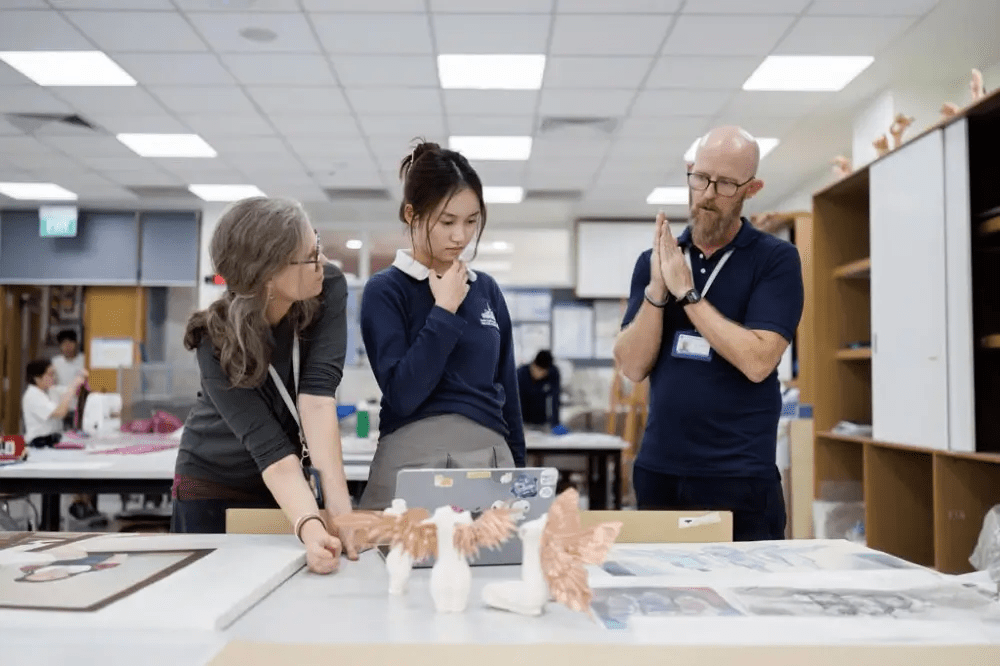
ISHCMC’s team of educators and counselors possesses the specific expertise required to guide students through the intricacies of the IB Physics HL curriculum.
Our physics teachers are experienced IB educators who understand the nuances of the curriculum and assessment criteria.
Our Future Pathways team also connects the physics curriculum to university goals; 98% of our students get into their top-choice universities.
Furthermore, our 2025 results highlight this success: an average IB score of 34 points (vs. global average of 30) and admits to top universities like Harvard, Yale, and Oxford.
Join a Community of Innovators at ISHCMC
The IB Physics HL curriculum is a demanding but highly rewarding course that opens doors to prestigious STEM careers. While the curriculum is standardized globally, the support system matters.
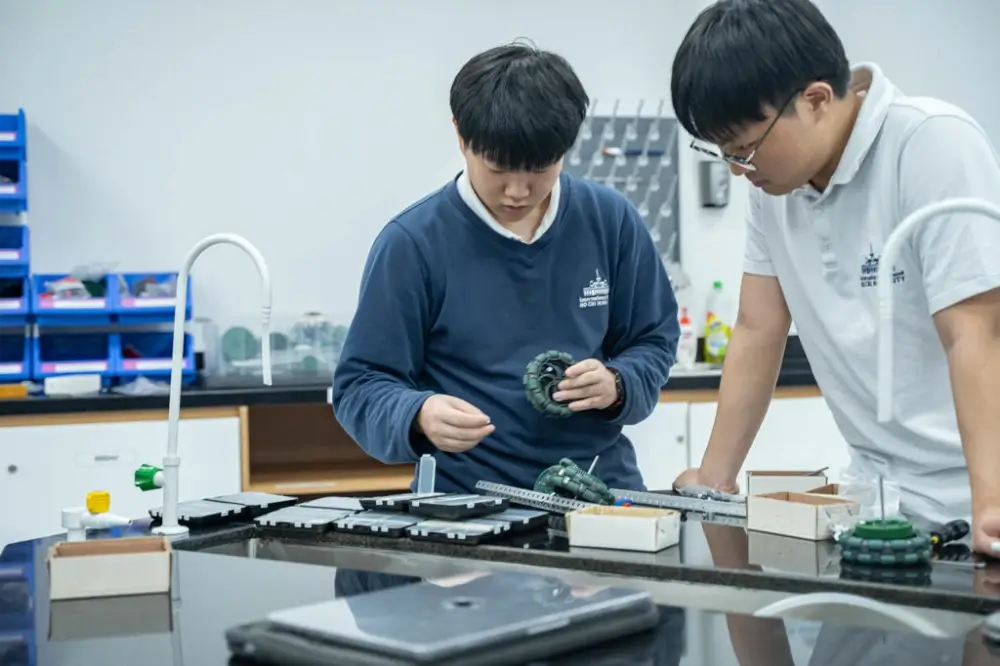
ISHCMC provides the facilities, teacher expertise, and emotional support systems (POSISH) necessary for students to thrive. We encourage parents to visit the campus to see the science labs in action and learn how we tailor the IB experience to individual student needs.
FAQs
Below are common questions parents ask regarding the IB Physics HL curriculum and its implications for their child’s education.
1. What is the main difference between IB Physics SL and HL?
HL students study additional topics and cover core concepts in greater depth, requiring 90 more teaching hours than SL. Consequently, HL is more mathematically demanding and better suited for students pursuing engineering or pure sciences.
2. Do universities prefer IB Physics HL for engineering programs?
Yes, top engineering programs often require or strongly prefer Physics HL because it demonstrates a student’s ability to handle rigorous quantitative and scientific coursework. It provides a foundational knowledge base essential for engineering degrees.
3. How much math is involved in the IB Physics HL curriculum?
Students need a strong grasp of algebra, trigonometry, and calculus, as these mathematical tools are frequently used to solve physics problems. The course assumes proficiency in math, making it essential for students to be comfortable with numbers.
4. Can a student take IB Physics HL without taking Math HL?
Yes, students can take Physics HL without Math HL, but it is challenging because the physics course requires high-level mathematical application. Students opting for this combination must have strong mathematical aptitude and dedication.
5. What career paths does IB Physics HL open up?
This course is ideal preparation for careers in engineering, astrophysics, architecture, computer science, and research. It also equips students with analytical skills valuable in finance, data science, and technology sectors.