Play-Based Learning vs Montessori: How to Combine the Best of Both?
Play-based learning and Montessori represent two influential approaches to early childhood education.
This article compares their philosophies, strengths, and limitations, helping parents understand how play-based learning vs Montessori models differ and how an integrated approach can support a child’s holistic development.
What is Play-Based Learning and Montessori?
Below, we outline how each approach operates in practice and how it supports foundational development.
Understanding Play-Based Learning
Play-based learning is an education approach that prioritizes child-initiated exploration, open-ended materials, and experiences driven by curiosity rather than predetermined tasks. It is usually applied during early childhood in various environments, including kindergartens, preschools, homes, and outdoor spaces.
Children engage in unstructured or semi-structured play, choosing from a variety of activities that spark imagination and discovery. Teachers facilitate by preparing environments, supporting interactions, and modeling language, but they do not control or dictate play.
This approach emphasizes social development through co-play, cooperation, and shared problem-solving. Dramatic play, construction, art, and sensory experiences promote creativity and emotional expression.
Play-based learning encourages holistic growth across cognitive, social, emotional, and physical domains. Children build intrinsic motivation, explore ideas freely, and enjoy learning processes that feel natural and engaging.
The Philosophy and Practice of Montessori Education
Montessori education centers on child-led growth within a carefully “prepared environment.”
Children move through the classroom independently, selecting hands-on materials designed to reinforce self-directed learning, sensory development, and purposeful engagement. Materials are self-correcting, allowing children to learn through discovery without direct adult intervention.
Classrooms typically feature mixed-age groups where younger children observe older peers, and more advanced learners reinforce skills by supporting others.
Montessori teachers act as guides: they observe, introduce materials at appropriate moments, and step back to allow uninterrupted concentration. Learning is framed as meaningful “work”, even though children often perceive these activities as enjoyable.
Comparing Montessori and Play-Based Learning Side-by-Side
Below is a detailed comparison to help parents understand how both methods differ and complement each other.
Structure and Freedom
Both approaches support child autonomy, but they differ in the balance of structure and flexibility. Montessori provides “freedom within a prepared environment” where activities are carefully curated and sequenced.
In contrast, play-based learning offers broader freedom through open-ended play opportunities with less predetermined structure.
Materials and Activity Types
Montessori environments use specific, sensory-rich materials with clear learning purposes. These are designed to isolate concepts such as volume, texture, quantity, or phonetic sounds.
Play-based settings include flexible materials, blocks, dolls, art supplies, imaginative props, and nature items, encouraging creativity rather than precise skill development.
Teacher’s Role
In Montessori, the teacher acts as a guide who demonstrates materials and then withdraws to observe. Intervention is minimal unless necessary for safety or redirection.
Play-based teachers act as facilitators who may join play, mediate interactions, scaffold learning moments, or adjust activities based on emerging interests. This makes the experience more socially dynamic.
Social and Cooperative Play
Play-based learning promotes group-based social interaction as a core feature. Children engage in co-play, dramatic role scenarios, and cooperative problem-solving.
In Montessori, social interaction occurs naturally but is not the focal point; children often work independently or alongside peers without formal group activities. Mixed-age settings allow natural peer teaching, but structured group play is less central.
Academic Readiness and Early Skills
Montessori introduces academic concepts through concrete materials early in development. Children may explore math, phonics, and sensory sequencing in systematic ways.
Play-based learning embeds academic foundations in play but typically introduces them more implicitly. Learning is integrated into storytelling, block building, pretend play, and exploration rather than formalized materials.
Suitability
Montessori may be especially suited to children who thrive with independence, routine, and structured self-paced learning.
Play-based learning may better support children who enjoy imagination-driven play, social collaboration, and flexible daily rhythms.
Understanding play-based learning vs Montessori helps parents assess what aligns best with their child’s temperament and developmental patterns.
Summary Table
| Approaches | Play-Based Learning | Montessori |
| Structure | Flexible, open-ended | Structured, prepared environment |
| Materials | Open-ended toys, imaginative props | Specific, self-correcting materials |
| Teacher Role | Facilitator, co-player | Guide, observer |
| Social Play | High emphasis, group-oriented | Emergent, less group-focused |
| Academic Approach | Embedded in play, informal | Systematic, hands-on academic tools |
| Ideal For | Children who enjoy creativity, social play | Children who enjoy independence, routine |
How ISHCMC Fully Develops Your Child’s Potential
At ISHCMC, we recognize that both flexible exploration and structured learning play essential roles in child development.
While not offering a Montessori-style pedagogy, we provide students with play-based learning to ensure each child receives a balanced, well-rounded educational experience.
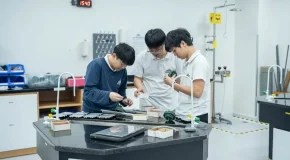
We cultivate a prepared learning environment enriched with hands-on, sensorial, and practical-life materials. At the same time, we provide open-ended play areas, art stations, and collaborative group activities that promote creativity, social growth, and imaginative expression.
Our teachers serve as guides who support independence and self-paced learning. They also actively facilitate peer interaction and cooperative play, helping children build emotional intelligence and social competence.
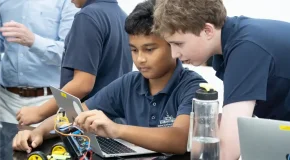
Mixed-age group settings also allow children to learn from and support one another, ensuring shared play experiences remain integral. Through this structure, each child discovers a learning path suited to their needs and interests.
Academic readiness is embedded in engaging, hands-on, and play-infused activities. We ensure that early literacy, numeracy, and cognitive skills develop naturally and confidently, preparing children for a smooth transition into formal schooling.
Through exploration, purposeful work, and meaningful relationships, we foster intellectual, emotional, social, and physical development.
Enroll With ISHCMC for Early Childhood Success
Understanding play-based learning vs Montessori helps parents make informed choices about early education. ISHCMC provides a nurturing, balanced approach that supports comprehensive development and joyful learning.
If you are seeking a balanced, child-centered, and holistic early-years education, consider ISHCMC. Contact us to learn more or schedule a campus visit to see our environments in action.
FAQs
Below are some commonly asked questions about play-based learning vs Montessori.
1. Can a child transition between Montessori and play-based programs?
Yes. Both approaches support independence and active engagement, making transitions manageable with proper support.
2. Which approach is better for academic readiness?
Montessori typically introduces academic concepts earlier, while play-based learning incorporates them more implicitly. Both can support strong academic foundations when implemented effectively.
3. Does mixed-age grouping benefit young children?
Yes. Mixed-age environments, used in Montessori and embraced at ISHCMC, allow younger children to learn from older peers while encouraging leadership in older children.
4. How does ISHCMC tailor learning to individual needs?
We observe each child closely, offer differentiated materials, and guide children toward activities that support their unique developmental trajectory.
5. What qualities should parents look for when selecting an early-years program?
Look for strong teacher-child relationships, safe and intentional environments, meaningful learning experiences, and alignment with your child’s temperament and needs.